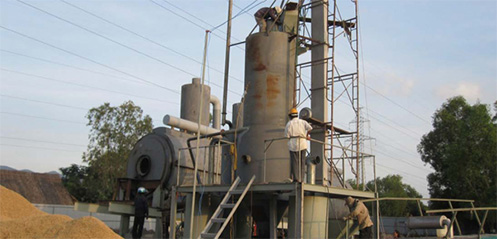
A CONTINUOUS-FLOW RICE HUSK GASIFIER FOR THERMAL APPLICATIONS

Last updated August 24, 2010

Alexis T. Belonio, Daniel A. H. Belonio, and Lucio Larano, August 2010

Observations: Design Principles for Charcoal Stoves

Last updated August 24, 2010
Christa Roth and Christoph Messinger, August 2010 Existing Charcoal Stove Existing Charcoal StoveImproved Charcoal Stove Improved Charcoal Stove Improving the Charcoal Stove for Haiti, Stove Camp 2010 (see the Stove Camp Summary for challenge details) Main points mentioned at the end of the Stove Camp Workshop
  1. We need a high turn down ratio.

    To bring water and foods fast to the boil, we need high power in the heat-up phase. However, thereafter we commonly need low power for simmering. The stove therefore needs to offer the opportunity to turn down the power output drastically. Options:

    1. Regulation of primary air supply (e.g. closing door)
    2. The gap between pot and charcoal is increasing over cooking time (shape of char container provides more depth = increased gap to the char)
    3. c) The amount of char available at the end of cooking is reducing (conical shape of char container = less char over time available)
  2. We need to reduce heat losses to the bottom and to the side of the stove.

    A char container radiates heat to all sides – not just to the pot. To reduce the amount of char used, it is important to reduce the heat losses to the other directions. Options:

    1. Bottom of stove: rebounding plate (with holes) in between primary air supply
    2. intake and charcoal container. Thus primary air is channeled through the
    3. heated rebounding plate, taking some heat back into the char container.
    4. Side of the stove: double wall with air in between for insulation.
  3. We need to maximize heat harvest from a given amount of charcoal.

    Charcoal burning is mainly influenced by the amount of air available in the char container. Options:

    1. A vertical spacer in the center of the charcoal container (Lanny Henson’s pig tail”) seemed to increase the availability of air for charcoal combustion.
    2. Additional draft (e.g. forced air) may increase heat generation per time unit. However, this may also increase CO emissions and reduce efficiency of char use.
    3. Secondary air to burn off the CO in a gap between the charcoal and the pot may provide additional heat. However, for this to be beneficial it may not impact on the surface area available for direct radiation from the charcoal to the pot and should not cool down the air in the gap (well preheated secondary air).
  4. We need to maximise heat transfer to the pot.

    Generating as much heat as possible out of a given amount of charcoal is one step. But another important step is to make sure that most of this heat actually is transferred into the cooking pot. Options:

    1. “Sunken pot” concept seems to provide best results in terms of heat transfer (Henson stove). Unfortunately, in real life this might not be possible in many work environments.
    2. Best heat transfer is NOT achieved if the pot rests on the char. Optimum is about 1inch away from the char, not closer than that. For Simmer, this could increase to 2-3 inches.
    3. A skirt is highly important to shield the gap area between the pot and the char against the influence of wind. The gap between pot and skirt should bedetermined.

Christa’s Summary of the stove camp

Observation and necessary actionDerived Design Principles
Charcoal radiates heat to all sides: as much can radiate towards the bottom of the stoves as can radiate upwards towards the pot. Action: Avoid loss of radiating and conducting heat from charcoal that is not directed towards the pot.
  • Add space between the charcoal grate and other stove parts: Lift the charcoal grate slightly off the bottom of the stove and increase the space to the sides of the stove.
  • Limit the places where the hot grate can conduct heat to other stove parts.
  • Add a deflector plate between charcoal chamber and the stove bottom to radiate heat back upwards.
  • Insulate the stove bottom to prevent heat loss through the bottom.
  • Insulate sides of the stove.
  • Regain heat through air circulation (air cooling of stove) by passing air through heated stove parts thus preheating air entering the combustion system. This can be by passing primary air through the deflector plate below the grate and/or secondary air through a gap between double side walls of the stove.
Charcoal combusts in function of the available oxygen. Thus heat generation is a function of air supply to the charcoal grate. Action: get the right amount of air to the charcoal grate. To little will choke the combustion, too much will cool the flue gases. If power of the stove is too low, increase air supply by
  • making more holes in the grate.
  • adding a ‘Henson pig-tail’ vertical air-pass through the charcoal bed.
Do not pile the charcoal up too high, as this will restrict air flow through the charcoal bed (this is influenced as well by the shape and particle size of the charcoal chunks).
The combustion of charcoal goes from oxidizing C to CO, then in a subsequent step from CO to CO2. CO is a toxic gas and has still considerable energy value. Ensuring a complete combustion will increase energy output and reduce toxic emissions. Action: avoid CO emissions.
Charcoal radiates heat but there is also considerable convection of hot flue gases. Action: Optimize transfer of created heat into the pot. Avoid obstructions between the radiating charcoal bed and the bottom of the pot (increase the view factor of the charcoal seeing the pot).

Bundled Corn Stalk Stoves for Malawi, Stoves Camp 2010

Last updated August 24, 2010
2010 Stoves Camp Corn Stalk Challenge

Dean Still, August 2010

One fine rainy morning two fine fellows from StrawJet (http://www.strawjet.com) , an Oregon company that makes equipment to bundle agricultural waste in Malawi, wandered into the lab and asked if it’s
possible to make a stove that uses bundled corn stalks to cook food. I said that I thought it was possible and after some conversation and testing of prototypes StrawJet put up a $250 prize to encourage Stove Camp participants to make it so.

Burning corn stalks leaves quite a bit of ash that does not fall apart but keeps its shape.
For this reason stoves must be adapted to deal with a lot of solid ash. Two types of stoves
were tested: 1.) A Jon Anderson Rocket Stove with lots of draft and a grate and 2.) Two
large TLUDs built by Paul Anderson and Art Donnelley that were vertically loaded.


Participants voted for the best stove that, in their opinion, was most effective. Jon
Anderson won the 2010 Cat Piss Award for a tall Rocket stove made entirely from found
materials that successfully burned the bundled corn stalks. The hope is that a pilot test
could be conducted in Malawi. If so, we’ll pass along the results.

Jon and his wife Flip have been in Haiti recently for three months helping folks to build
these kinds of Rocket stoves. They are beautiful, dedicated people, who like many folk at
Stove Camp, deserve real praise and adoration. I’m happy to send them some of both and
congratulations for making a wonderful stove!

Stoves Camp 2010 Charcoal Stoves for Haiti

Last updated August 24, 2010

Stoves Camp 2010, Cottage Grove Oregon

Stoves Camp ParticipantsStoves Camp Participants

Fifty two high energy participants attended Stove Camp this year at Colgan’s Island, camping near the river, making and testing stoves, and listening to Fred’s Big Band harmonize so beautifully. Fred and his volunteers cooked breakfast every morning and dinners at nighttime parties on Rocket and TLUD institutional stoves.


Nick Salmons from International Lifeline Fund made a very successful Haitian charcoal stove that was voted “Best in Class” by his peers!

Stove Camp provides a venue for a gathered scientific community to advance knowledge of biomass cook stoves. Participants made new stoves and tested them daily for fuel use and emissions. Every morning the test data was shared and new stoves were constructed.

This year, a great deal of progress was made on charcoal stoves for Haiti. Camp participants, some of whom have worked in Haiti,designed a two-hour Water Boiling Test for Haiti, which uses a Haiti pot
and mimics a typical cooking task, cooking rice and beans. Charcoal stoves were constructed that used less fuel and produced less carbon monoxide compared to traditional Haitian stoves.

See the attached Stoves Camp Report for details of the tests, the interesting findings about the optimum charcoal to use for each stove, and pictures of the stoves tested.

Testing of the Anila stove in India August 2010

Last updated August 22, 2010

The aim of this test was to finalise the design of the Anila stove, which had been produced in India ready for distribution to households to gather feedback from them about usability.
This is for the project: http://biocharinnovation.wordpress.com/

Without wanting to change the design too much from the original plans, the following changes were deemed necessary –

Haiti's Transition from Woodfuels to Liquid Biofuels: Cooking with Bioethanol - Project Gaia

Last updated August 17, 2010
Haitian Girls at Viva Rio's Orphanage in Carrefour Sample a Traditional Meal Prepared on the CleanCook Stove

Patrick Bringardner, Project Gaia, August, 2010

A recent assessment conducted by the Women’s Refugee Commission in Haiti found that the price of charcoal has risen by 40% (WRC and WFP 2010). Helping subject populations to develop the capacity to produce liquid biofuels may offer one important solution to energy poverty in Haiti’s displaced communities and contribute to its long term development of energy self-sufficiency.

Clean Cook StoveClean Cook Stove

Project Gaia has been working in Haiti to promote ethanol and the CleanCook Stove - an alcohol based stove - as an alternative to stoves that burn solid biomass (i.e. wood, charcoal, and briquettes.) Ethanol is as clean as LPG, cheaper than charcoal, safer than kerosene and has greater potential than trash briquettes. In Africa, Project Gaia has accumulated over 2 million days of cooking with the CleanCook Stove without a single accident of any significance.

The most common question which arises during our discussions with policy makers and social entrepreneurs is:** “Would the supply of ethanol be sustainable? And where would the supply come from after donations were at an end?” **

This is the key sustainability question and the reason why we are so interested in Haiti. Not only was Haiti once a leading sugar producer and a distiller of beverage ethanol for export as well as the local market, but also Haiti exists on trade routes over which billions of liters of ethanol flow each year on their way to a fuel market in the United States. This ethanol, mostly from Brazil, generally the most competitively priced in the commodity market, will provide a source of fuel for Haiti—cheaper than kerosene—as Haiti builds up its own local production (Ethiopian Petroleum Enterprise Data). In fact, the Brazilian Government has pledged to donate over 100,000 liters and an additional 400,000 liters over the next two years.

Haiti was once a powerful agricultural economy, producing for its own needs. In 1983 Haiti harvested 70,000 hectares of sugarcane. Today it harvests less than 17,000 hectares (Figure 1: Decline in Sugar Cane Production (UN Data World Statistics Pocketbook)). Haiti’s dependence on export markets has increased its vulnerability through its reliance on basic sustenance items it once produced locally. Today it supplements most of its own food staples with imports – a precarious equilibrium. Other than charcoal, most other fuels are imported.

In regards to domestic ethanol production, Haitians are no strangers to the distillation of alcohol. Thousands of small mills and distilleries make beverage-grade ethanol in Haiti. In Léogâne alone, over 200 small distilleries were in operation before the earthquake (ESMAP 2007). Many of the existing distilleries in Haiti, those shut down or still in operation, could be repaired and refurbished to produce fuel grade ethanol. Project Gaia has been in contact with an operating distillery in the vicinity of Léogâne that could upgrade to produce hydrous ethanol fuel and put this fuel into the market in a matter of months.

Many opportunities exist for small scale distilleries. In Haiti, some small ethanol enterprises are already active thus presenting the perfect opportunity for value chain development through the support of SMEs (small and medium enterprises). The number of sugarcane transformation workshops throughout the country is an estimated 5,612 (ESMAP 2007)

Haitians rightly believe that Haiti’s way back from dependency is through agriculture and a renewed attention to domestic needs and markets. Therefore, by developing ethanol as a household fuel, it will profoundly benefit Haiti because Haitians can produce biofuels from their own agricultural crops. Moreover, Haitian families will finally have access to cooking fuel that is safe, clean, affordable and sustainable. A way back to economic - and human - health for Haiti is to produce ethanol for its domestic energy market.

Downdraft and Cooking Stove Patents

Last updated August 12, 2010

Contributed by Crispin Pemberton Pigott


the described features are incorporated in the Saral Stove and Sampoorna Stove - as noted in the patent

Stoves Design and Principles

Last updated August 07, 2010

The stoves design and principles are explained with simple sketchs. Many stove designs are existing, but most common designs are presented here.

Testing of the Sampanda stove in Cambodia 12.07.2010

Last updated August 12, 2010

I am looking to get some Anila stove units in India for some small-scale trials - if you can help please get in touch asap with sarah.carter [at] ed.ac.uk

Testing of the Sampanda stove in Cambodia 12.07.2010
Sarah Carter, UK Biochar Research Centre

See http://www.bioenergylists.org/content/testing-andersons-tl for a similar test on Anderson's TLUD, and http://www.bioenergylists.org/content/testing-everythingni for testing of EverythingNice stove, and Anila stove http://www.bioenergylists.org/content/testing-anila-stove.

Stove: Sampanda stove. Produced by the Samuchit Enviro Tech Pvt Ltd in India.
Test: A water boiling test (time to boil 2.5 litres of water, in a pan without a lid)
Location: The Iron Workshop, Siem Reap. A well ventilated building – 2 surrounding walls, and a roof. Wind conditions were low, but blustery at times.

Pyrolysis Temperatures Profiles of a Large TLUD Stove

Last updated July 12, 2010
Large TLUD

I learned to make TLUDs from Dr. Paul Anderson when he came to do a stove & biochar demonstration for Biochar Ontario in June 2009. Since my primary interest was in producing biochar, I went home and began building a larger version of the “Champion” TLUD stove from a 55 gallon drum and a 25 gallon drum (pictured above.) I have been following this list since then and on “Dr. TLUD’s” urging, I thought should begin sharing with this community what I have been learning.

The “Large TLUD”

Syndicate content